

Designing Smarter Wind Farms: Why Exclusion Zones Matter
Wind farms design is becoming increasingly data-driven, but one challenge remains stubbornly constant: reality. Every potential project area , whether stretching across rural landscapes or spanning offshore waters, comes with a maze of constraints. Environmental protections, buildings, roads, grid infrastructure, terrain limitations, and regulatory buffers all shape what is truly buildable.
Yet in early-stage planning, these constraints are often scattered across datasets, manually drawn, or simply overlooked until late in the process. The result? Layouts that look good on paper but fall apart when confronted with real-world boundaries. Developers waste valuable time redrawing layouts, reconciling datasets, and iterating scenarios that were never feasible in the first place.
Youwind’s exclusion zone functionality bridges this gap. By transforming constraints into clearly defined, actionable no-go areas, it helps teams design realistic layouts for wind farms from day one, unlocking smoother workflows and more reliable outcomes.
Turning Real-World Restrictions Into Buildable Wind Farms
Wind farm planning is never as simple as drawing a boundary and placing turbines. Sites, onshore or offshore, comes with a landscape of limitations: protected habitats, lakes and rivers, residential areas, roads and power lines, airports, forests, steep slopes, or project-specific restrictions.
Ignoring these constraints early on leads to unrealistic layouts, costly redesigns, and avoidable delays later in the development process. Yet manually mapping all these limitations can be time-consuming and prone to error, especially when working across large areas or integrating multiple data sources.
Wind developers need a way to ensure their layouts are buildable from the very beginning, without spending days drawing and redrawing restricted areas, especially as wind farms grow in size and complexity.

Exclusion Zones That Automate Smarter, Feasible Layouts
Youwind solves this by introducing exclusion zones, geographical areas where turbines cannot be placed. Once defined, these zones automatically guide the layout generator, ensuring turbines are never placed where they shouldn’t be.
And creating them is simple, with three flexible workflows:
● Draw directly on the map
Create custom polygons for restricted areas, name them, and save them, perfect for project-specific constraints.
● Upload GIS files
Import existing spatial data when precise boundaries already exist.
● Automatically screen map data
Use Youwind’s automatic exclusion screening tool to convert visible map features like roads, airports, buildings, forests, water bodies, wetlands, slopes, substations, and more, into exclusion zones. You can apply buffers, preview results, and either cut them from the buildable area or save them as clear reminders of the exclusion areas.
Once in place, the layout generator respects all exclusion zones and buffers, optimizing turbine placement around the remaining available land.
This ensures layouts remain realistic and compliant across all development areas, without requiring manual correction every time a scenario is updated.
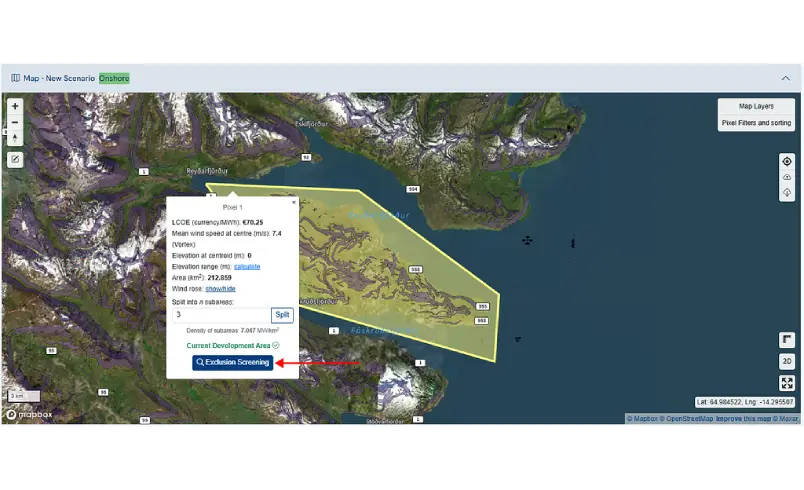
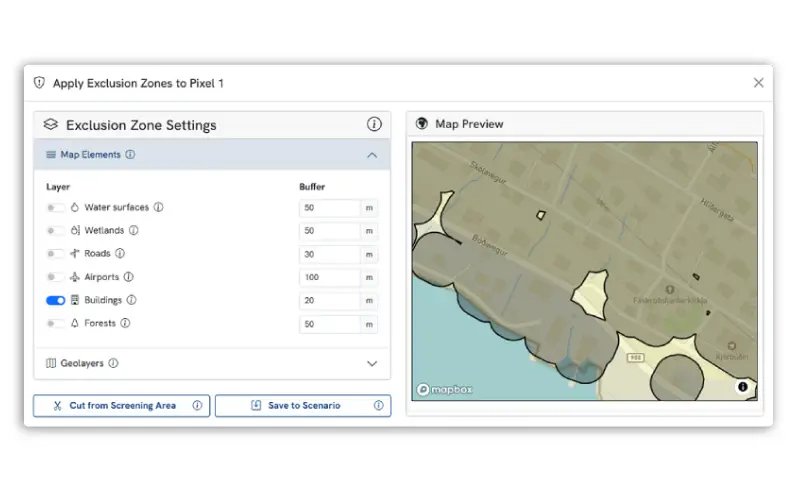
From Constraint Chaos to Confident Decision-Making
Defining exclusion zones isn’t just about setting boundaries. It’s about enabling smarter, faster, and more coordinated project design.
● Faster, more reliable design cycles
By filtering out infeasible areas early, developers reduce time spent on unrealistic scenarios and accelerate convergence toward viable layouts.
● Better cross-team alignment
With a shared GIS layer/library as the single source of truth, engineers, GIS specialists, analysts, and permitting teams all work from the same validated inputs, minimizing confusion and version conflicts.
● Higher-quality decisions
When constraints are explicitly defined and automated, layouts become more accurate. This improves the downstream financial, technical, and regulatory decisions.
● Stronger project confidence
Whether presenting to internal stakeholders or external partners, teams can demonstrate that their layouts account for real-world conditions, not assumptions.
● A foundation for advanced optimization
Clear exclusion zones make every subsequent step, from micro-siting to energy yield assessment, more predictable, transparent, and efficient.
In essence, exclusion zones turn the messy complexity of real-world site constraints into a structured, scalable design process. They help wind farms progress more efficiently from concept to construction and give developers the clarity needed to reduce risk, save time, and build projects that are feasible not just in theory, but in practice.
Request a demo
Get a first-hand look at how Youwind can support your wind energy management and development, whether onshore or offshore. Fill out the form and we’ll be in touch to schedule your personalised demo.
Related Knowledge
 December 11, 2025
Designing Offshore & Onshore Foundations: Building the Backbone of Every Wind Farm
Early-stage offshore wind project development often prioritizes wind resource and layout optimization, while foundation feasibility is deferred to later design stages. Whether positioned far offshore or on land, foundations ensure turbines remain stable, safe, and accessible throughout decades of operation. As projects grow in size,…
 November 18, 2025
A Fast and Complete Site Suitability Evaluation for your Wind Park
Before any design work begins, every wind park requires a thorough understanding of its environmental and operational constraints. Fast, reliable site suitability assessments help developers anticipate risks, validate turbine choices, and ensure that early decisions are backed by accurate data rather than assumptions. With the…
 November 5, 2025
Predicting the Sound of Progress: Noise Propagation Modeling
Youwind Platform Guide As wind energy expands closer to communities, managing acoustic impact is becoming an essential part of responsible project development. Regulators and local residents increasingly demand transparency around noise emissions, while developers must ensure compliance without compromising efficiency. Traditionally, evaluating sound propagation across…