

Repowering wind farms: Maximizing electricity production in mature wind markets
Why repowering is becoming a key opportunity
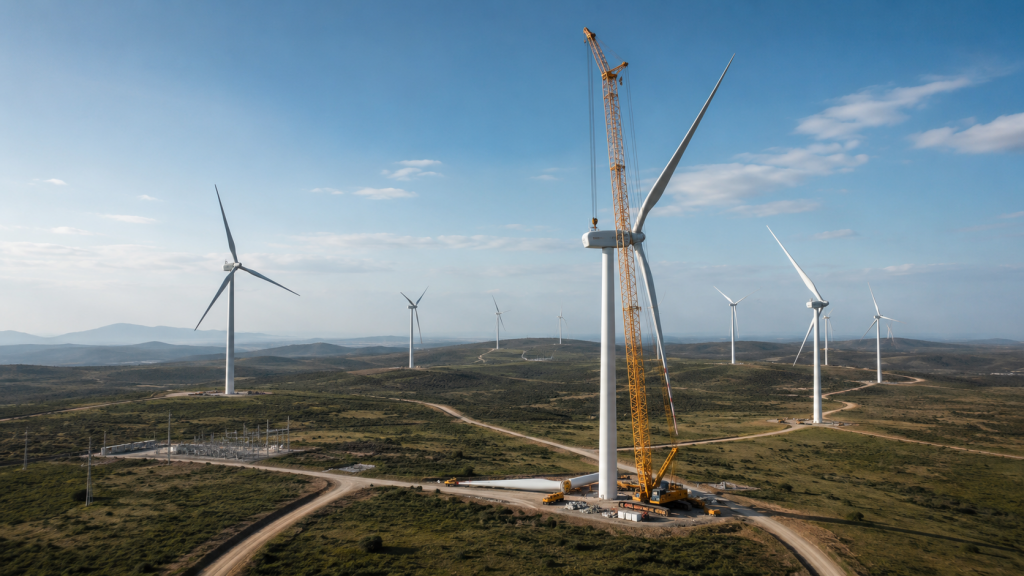
In mature wind markets, many first-generation wind farms are nearing the end of their operational life. While many of these sites may still offer attractive wind resources, older turbines tend to be less efficient, require more maintenance, and don’t integrate as smoothly with modern grid systems.
Repowering, replacing older turbines with newer, high-performance models, is emerging as a major opportunity for developers. It allows them to increase energy production while making use of an existing wind farm.
Key drivers for repowering
Repowering projects bring several benefits:
- Higher efficiency turbines: Modern turbine models can offer higher rated capacity, harvess more energy from the wind with bigger swept areas as well as offer different performance characteristics to adapt to the site at its fullest. Such technology improvements create opportunities to increase electricity production depending on site conditions while minimizing turbine units at site.
- Re-use grid connection permits: Repowering offers an opportunity to improve the business case for one same project, which has already granted grid capacity at a specific grid connection point. Having grid capacity ensured is already a valuable asset in itself.
- O&M considerations: New turbine technology can improve O&M requirements and associated costs over the project lifetime.
Challenges in repowering
Repowering isn’t without its challenges:
- Infrastructure limits: Existing foundations’ assessment of fatigue capacity left, viability of current access roads for bigger turbine components, and electrical connections may restrict layout options.
- Permitting complexity: Repowering may require new or updated approvals, particularly when layouts, turbine dimensions, or other project characteristics change.
- Grid capacity: Some grids may need upgrades to handle increased output.
- Environmental reassessment: Even established sites may require updated studies. With bigger turbines, affected heights range change and therefore, the relevant environmental impact for such heights must be assessed. Relevant studies in this case are birds pattern behaviors or height constraints due to aeronautical infrastructure.
- Community engagement: Local support from the start is essential for a smooth project rollout.
Maximizing production while minimizing turbine count
One of the main goals in repowering is to increase electricity production while evaluating whether fewer, high-capacity turbines can meet new project requirements.
This approach can help developers explore trade-offs between electricity production, turbine count, project constraints, and costs. Scenario analysis tools help developers compare different layouts and turbine technologies to find the optimal combination of yield, cost, and feasibility
Financial considerations and business case optimization
Repowering isn’t just a technical choice, it needs to make financial sense too. Developers should consider:
- Upfront capital costs versus long-term operational savings
- Optimizing the Levelized Cost of Energy (LCOE)
- ROI for different turbine technologies and layouts
- Trade-offs between maximizing output and minimizing initial investment
Greenfield vs. repowering projects
Unlike greenfield projects, repowering starts from an existing wind farm site, with deep knowledge on site wind resource data, while it may be able to re-use or adapt some existing infrastructure, depending on the new project configuration.
This requires reassessing layout design, electrical systems, existing infrastructure, site constraints, and project economics for the new configuration.
How Youwind supports repowering
Youwind’s platform supports repowering analysis by bringing technical and financial evaluation into an integrated workflow:
- Comparison of existing and proposed layouts across relevant engineering and financial indicators, accounting for best available wind resource data at site for higher certainty
- Scenario analysis to evaluate multiple turbine models and layout options
- Electrical design tools to evaluate cable routing, substations, grid losses, and other electrical system requirements for proposed configurations
- Yield and wake loss modeling to optimize electricity production
- LCOE calculations and financial modeling to compare the business case across scenarios
- GIS constraint analysis and exclusion zones to incorporate relevant new site and infrastructure constraints into layout development for environmental, community, and grid limitations
- Comparison of multiple turbine technologies against site conditions for site suitability purposes based on turbulence intensity calculations
By empowering developers to compare technical and financial scenarios within the same workflow, Youwind supports smarter decisions and more profitable projects.
Why this matters
In mature wind markets, repowering can provide an opportunity to increase electricity production from existing wind farm sites while reassessing the technical and financial configuration of the project.
Using integrated tools for layout optimization, financial analysis, and scenario comparison can help developers evaluate trade-offs, compare project options, and make more informed repowering decisions.
Request a demo
See how Youwind helps wind energy teams compare repowering scenarios, optimise new layouts and evaluate how turbine replacement affects energy yield, LCOE and project profitability. Fill out the form and we’ll be in touch to schedule your personalised demo.
Related Knowledge
 September 30, 2026
Youwind Newsletter October 26 Edition
Welcome to the October edition of the Youwind newsletter Each month, we’ll bring you the latest key developments in wind project design, product updates from our platform, company news, and a look at what our team has been working on. You’ll also find upcoming webinars,…
 August 10, 2026
Youwind Newsletter September 26 Edition
Welcome to the September edition of the Youwind newsletter Each month, we’ll bring you the latest key developments in wind project design, product updates from our platform, company news, and a look at what our team has been working on. You’ll also find upcoming webinars,…
 July 9, 2026
Offshore Wind Auctions in Europe during second half of 2026: How Developers Can Respond Faster to AO9, AO10 and AR8 Opportunities
Offshore wind project development has always involved uncertainty. Developers need to evaluate numerous conditions: wind resource, seabed geophysical and geotecnical states, grid access, environmental constraints, logistics with the right harbour, electrical infrastructure, financial viability… Everything long before a project reaches maturity. Nowadays, the pressure on…